

What Menopause Care Could Look Like When Every Visit Starts With the Full Picture


Clinicians, like myself, are asked to perform heroics in menopause care. A patient in midlife presents and describes disrupted sleep, changes in mood, hot flashes, brain fog, or new physical symptoms. The onset of their symptoms may span months or years, and have a varied impact day over day. At the visit, the clinician listens to the patient, and considers differential diagnoses. Our first step in evaluating patients often includes sending them out for further testing. Yet, laboratory testing and imaging alone do not provide reliable tools to evaluate perimenopause and guide care. This leaves a gap – in the current state of care there is no traditional objective data that can support the patient in her storytelling or the clinician in their decision making. This has been described as perimenopause uncertainty, and it contributes to frustration that both patient and clinician experience.
At Oura, our women’s health team is unsatisfied with the status quo, and we are re-imagining what menopause care will be in the near future.
“The future of menopause care gives weight to the impact of symptoms on a woman’s quality of life and the objective signs, measured over time, of changes in sleep, stress, burnout, cardiovascular and metabolic health.”
What perimenopause care should become
An ideal model of menopause care would begin with the patient’s lived experience and add meaningful, measurable context around it.
Imagine this: A female patient has been completing a structured assessment over the last several months of how their symptoms are affecting daily functioning. Prior to the visit, the doctor can review those assessments alongside longitudinal, objective wearable data patterns across sleep, heart rate and stress. The data is summarized, easy understand, and within the existing medical record software. This combined patient reported data as well as wearable metrics would give the clinician a better view of what’s been happening prior to the first encounter.
The visit conversation could then move beyond asking “How are you feeling today?”— which requires the patient to both consider current symptoms and the symptoms of the past few months that drove them to seek an appointment in the first place — and start from a place of shared understanding.
In a future state of menopause care, incorporating wearable data with structured and validated survey data, like the Menopause Impact Scale, can help visits focus on:
- Which symptoms are having the greatest effect on quality of life?
- When did those changes begin, and how have they evolved?
- Are the reported symptoms consistent with changes in sleep or other physiological patterns?
- Which combination of treatment, behavioral strategies, and lifestyle support is appropriate for this patient?
- If treatment was delivered in a previous visit, has it improved her quality of life?
In the ideal state of care, after a clinician-prescribed intervention, the patient has tools to track their perimenopause symptoms over time and objective measures to keep an eye on between visits. At the next visit, the data on progress already exists. Clinicians can return to the longitudinal measures and ask whether the patient’s quality of life has improved, whether symptoms have changed, and whether physiological patterns have moved in a meaningful direction.
This is the shift from episodic management to longitudinal care. It does not mean that every patient needs more data, more testing, or more technology. It means that the information collected should help clinicians understand the patient’s priorities and physiology, make better-informed decisions, and evaluate whether the plan is working.
The role of Oura: Connecting symptoms and signs with longitudinal data
We are not imagining this future. We are building it.
The Menopause Impact Scale (MIS) adds a structured measure of the patient’s experience. Rather than focusing on how frequently a symptom occurs or how severe it seems in the abstract, the MIS asks how much each symptom has affected quality of life over the previous two weeks. It covers 22 symptoms across seven domains, including cognition, sleep, vasomotor symptoms, musculoskeletal pain, urinary symptoms, sexual function and vaginal symptoms, and body image. The MIS was evaluated with more than 2,900 participants and is designed for repeatable use.
But that data is not trapped on the patient’s phone. This information can be brought into care settings along with summaries of sleep patterns, stress levels, and activity.
A model of what this looks like
Consider a patient in midlife who presents with fragmented sleep, daytime fatigue, and difficulty concentrating. In a conventional visit, she may describe several months of symptoms from memory. The clinician may address the most disruptive complaint, while other concerns remain less visible.
In a more connected model, the patient completes the MIS before the visit and shares several months of Oura trends with her consent as part of the clinical care visit.
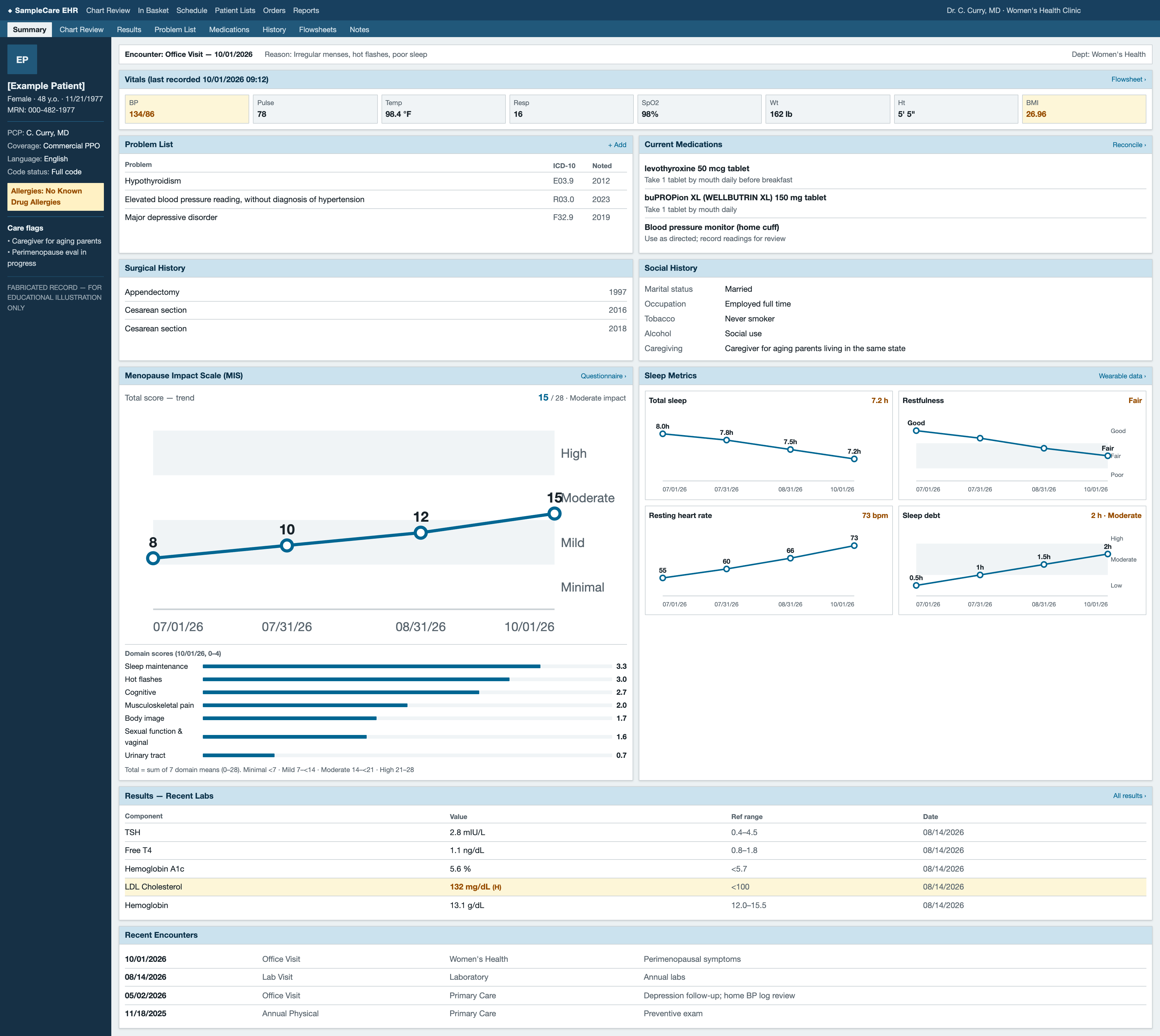
Figure 1: Demonstrates increasing Menopause Impact Scale scores, decreasing total sleep and restfulness, as well as increasing heart rate and sleep debt data within the medical record.
The MIS shows that sleep, vasomotor and cognitive symptoms are having the greatest effect on daily functioning. The longitudinal Oura data shows a sustained pattern of reduced sleep continuity. Together these tools provide a benchmark for pre and post-intervention.
For example, if a patient starts on transdermal estradiol and oral progesterone, they go home with the tools to track not only how they feel, but how their body is responding. By the follow-up visit, the patient arrives already aware of measurable improvements, while the clinician can see at a glance what is trending in the right direction. In this model, continuous data and automated insights bridge the gap between appointments — preserving time for the cornerstone of medicine: the human connection between patient and provider.
This model is not about promising that every symptom will map neatly to a biometric signal. Symptoms and signs don’t always perfectly match. It is about creating the conditions for better questions, better shared decisions, and more meaningful follow-up.
Early learnings: why longitudinal context matters
Oura’s work in women’s health is helping clarify why a longitudinal approach may be useful in midlife care.
In the Oura’s Perimenopause Report, aggregate, de-identified data from more than 100,000 female members showed measurable changes in sleep and physiology across the menopausal transition. The report found that women in perimenopause experienced up to two hours less sleep per week compared with premenopausal and postmenopausal groups, and that heart rate variability declined by approximately 20–30% across the transition.
Early findings also suggest that initiation of hormone therapy has impacts on objective sleep metrics, and that a single point in time or a single number would miss trends. Evaluating the de-identified data of 2,406 female members over the age of 40 who started tagging hormone therapy, we found that at the population level, Sleep Scores improved subsequent to the first tag, while sleep wake-ups decreased.
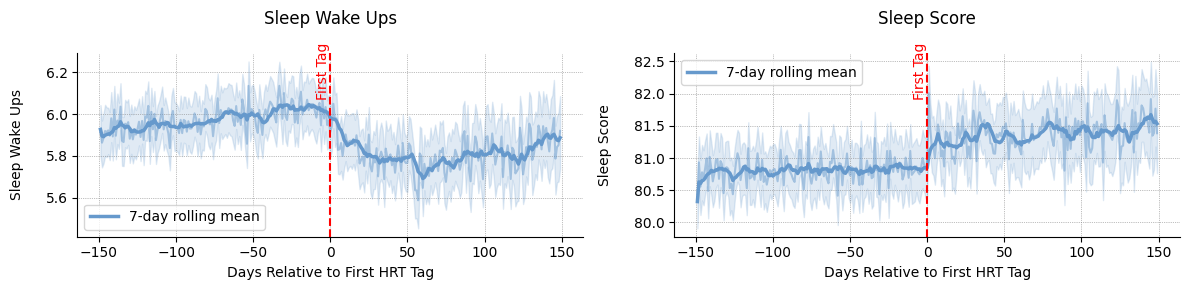
Figure 2: Average nightly sleep wakes and sleep score for 2,406 female members over the age of 40 for 150 days before and after starting to tag hormone therapy. Shaded region is 95% confidence interval, faint line is raw population mean and thick line is a 7 day rolling window average of the population mean.
These findings do not establish diagnostic thresholds, explain the cause of an individual patient’s symptoms, or determine treatment. They illustrate something more foundational: meaningful changes can unfold gradually and may be difficult to capture in a single clinical snapshot.
The MIS provides the complementary patient-reported layer. In clinical use, its total and domain scores can be repeated and reviewed as trends. This creates a way to ask not only whether a symptom is present, but whether it is affecting the patient’s life and whether that impact is changing. We have guidance on how to use the MIS in care ready for providers.
What providers can do now
Clinicians and care organizations do not need to wait to move toward more connected menopause care.
- Ask patients with Oura Ring to take the MIS at the right frequency to match their care delivery
- Review the data using the downloadable PDF if connected care is not available
- If your health system is ready to bring biometric data into daily practice and see it within or alongside the EHR you already use, contact the Oura team.
What patients can do now
Patients can also help make the clinical conversation more complete.
- Track the symptoms that matter most to daily functioning.
- Complete the Menopause Impact Scale
- Review trends over time rather than focusing on a single day or score
- Bring questions, reports, and relevant changes in treatment or lifestyle to the clinical visit
- Share Oura data with a provider or care partner only through a consented, trusted workflow
- Use wearable data to support—not replace—medical evaluation and individualized care
Better menopause care will not come from one score, one sensor, or one treatment. It will come from bringing the patient’s voice and the body’s changing signals into the same conversation, then returning to that conversation over time.
Signs + symptoms + time can help turn a brief encounter into a more continuous understanding of care.
In good health,
Dr. Chris Curry, Clinical Director of Women’s Health at Oura
Notes
Oura Ring is not a medical device and is not intended to diagnose, treat, cure, monitor, or prevent medical conditions or illnesses. Please do not make any changes to your medication, nutrition, or workouts without first consulting your doctor or another medical professional.


